aifora Competitive Pricing
Designing AI-driven decision support that enables pricing and inventory optimization across large-scale retail operations.
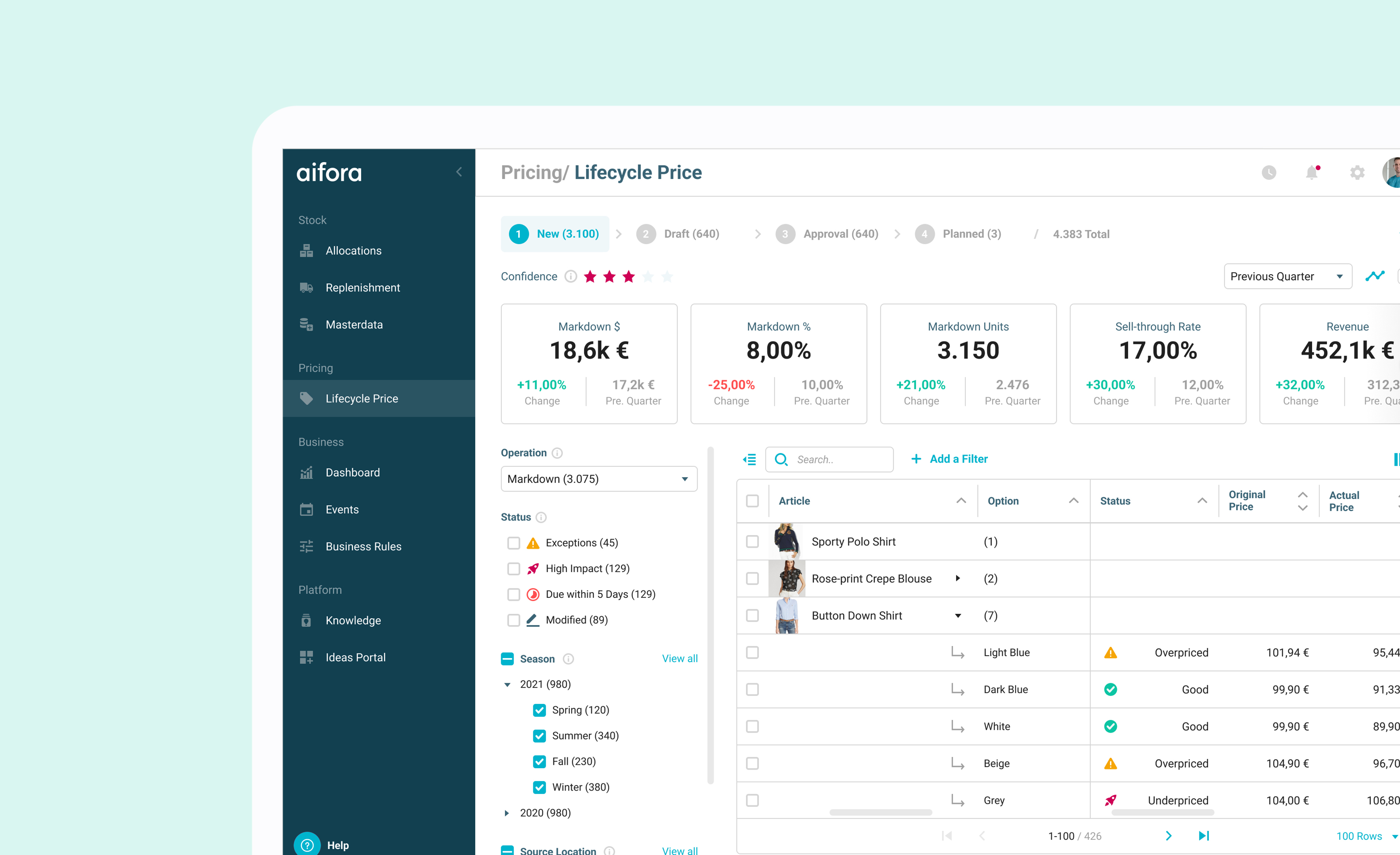
B2B retail teams using AI-driven pricing and inventory optimisation. · B2B retail AI · Series B · EU market





Retail pricing teams operate across thousands of SKUs, regions, and price points, yet lacked a reliable way to understand competitive positioning at scale. Existing tools made it difficult to compare market prices across variants, sizes, and time, forcing teams to rely on fragmented spreadsheets, manual analysis, or intuition.
Without a scalable, integrated view of competitor pricing, pricing decisions were slow, reactive, and hard to operationalize — limiting the ability to act on AI-driven forecasts and directly impacting margin optimization and inventory efficiency.
I conducted interviews with key B2B stakeholders — including Country Pricing Managers, Sales, and Product Owners — to understand how pricing decisions are made across different retail models and where current workflows break down.
- Distinct pricing needs across customer types — two primary segments emerged (brand retailers and resale retailers) with different competitive dynamics, requiring flexible pricing logic.
- Market context is as critical as recommendations — users needed visibility into the best available market price alongside competitor benchmarks to build trust in AI-driven suggestions.
- AI recommendations must be explainable — customers expected pricing suggestions to be grounded in aifora's data and transparent enough to support confident decision-making.
- Historical pricing trends influence strategy — interest in competitor price history over time highlighted the importance of trend awareness, not just point-in-time comparisons.
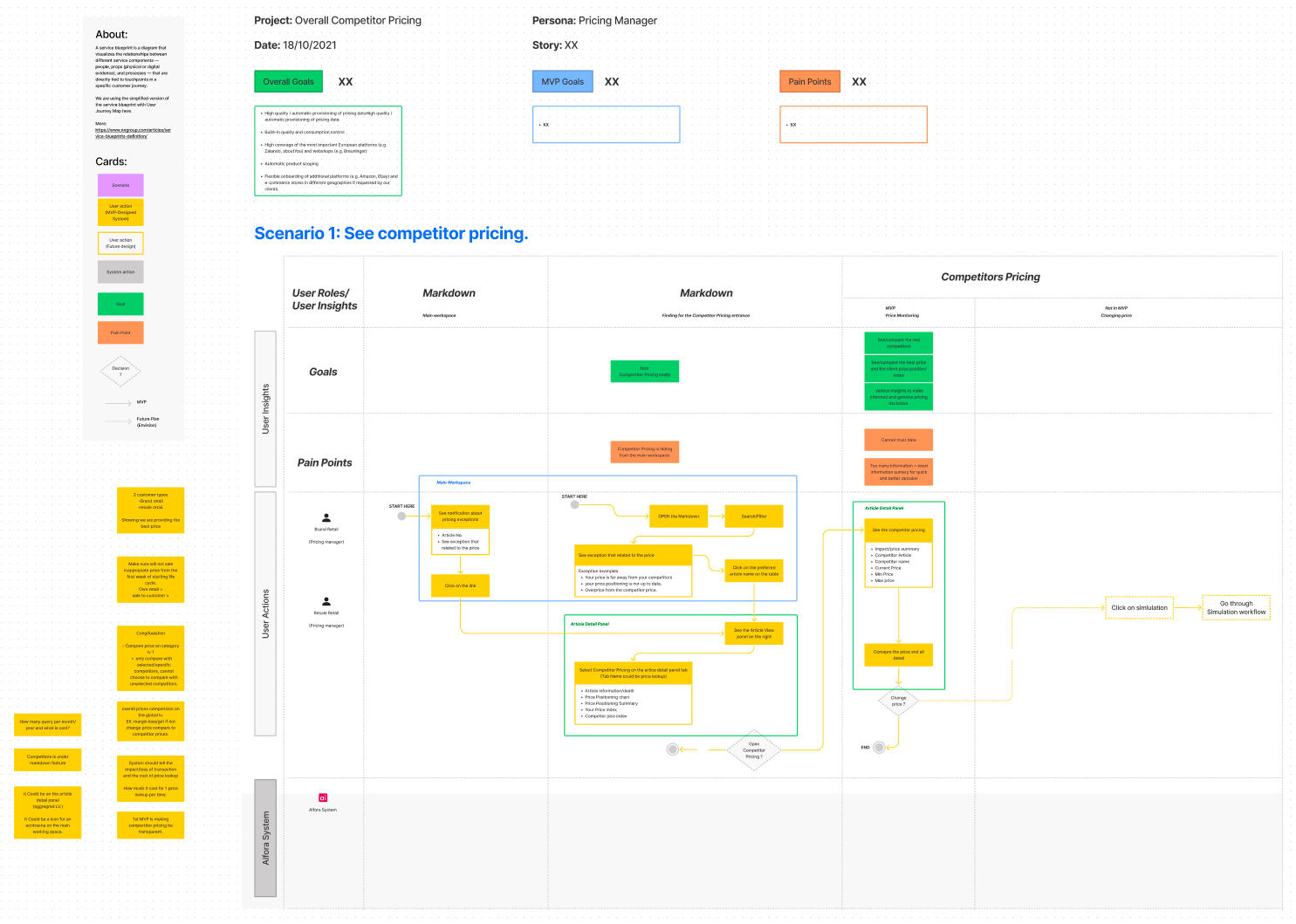
- Design for heterogeneous retail models — the solution must support fundamentally different pricing strategies across brand and resale retailers without forcing a one-size-fits-all interaction model.
- Make competitive position immediately legible — users should understand their market position at a glance, surfacing own price, market min/max, and price index as primary decision signals.
- Enable trend-aware pricing decisions — pricing decisions should be informed by recent market dynamics, providing short-term historical context (minimum 7 days) to support confidence beyond point-in-time comparisons.
Strategic Direction
I explored multiple early concepts through sketches, focusing on how competitor prices, price ranges, and historical trends could be compared clearly across items and sizes. Four directions were reviewed with Product and Engineering to assess trade-offs around data density, usability, and feasibility.
One direction was selected as the strategic baseline, as it best supported fast market comparison while remaining flexible for different retail models. I then led the creation of a low-fidelity storyboard to define the core flows — from scanning competitor prices to reviewing trends — while incorporating cross-functional input to address technical and MVP constraints early.

Design System Update
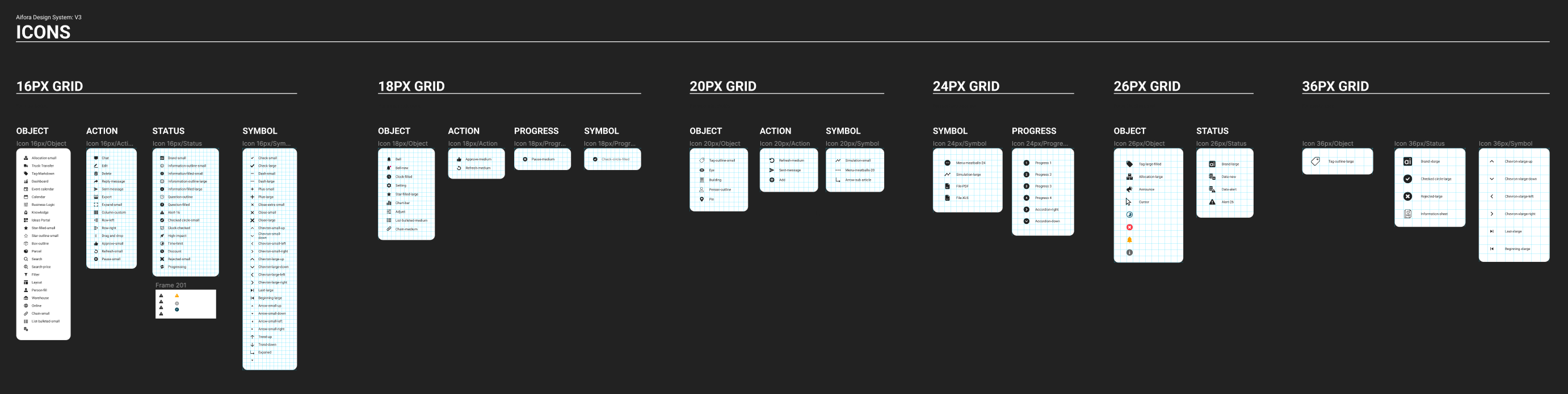
As aifora's first in-house designer, I evolved the existing Design System — initially created by external consultants — into a more modern, scalable foundation. Built on Ant Design, the updated system improved consistency and supported complex data-heavy features such as Competitive Pricing.
The new Design System was applied across the product to ensure coherence and faster iteration.
Prototype
A high-fidelity prototype synthesized insights from research, concept exploration, and design evaluation, and was used to validate decision confidence, interaction clarity, and scalability through user testing.
I conducted usability testing with six customers from large German retail brands and one aifora Product Manager to validate the Competitive Pricing prototype and assess decision clarity.
- Critical signals needed stronger visual emphasis: a table-only presentation made it difficult to quickly identify important numbers. Users expected visual cues to surface key pricing signals at a glance.
- Pricing and history needed clearer integration: separating current pricing and pricing history across different tabs caused confusion. Users expected a more seamless relationship between price comparison and historical context.
- Longer historical context was required for strategy: while short-term history was helpful, users needed access to extended pricing trends to inform longer-term pricing decisions.
These insights informed targeted refinements to improve signal visibility, interaction clarity, and strategic depth, while preserving the core comparison model.
Impact
- Customer growth and regional expansion: The feature directly supported acquisition of 13 new customers and enabled entry into new markets, with targeted adoption driven by sales efforts in the UK and Ireland.
- Business momentum and investor confidence: Delivery of the feature contributed to successful progression from Series A to Series B funding, strengthening confidence in aifora's product vision and execution.
- Strategic acquisition: The platform's demonstrated value and scalability contributed to aifora's acquisition by Centric Software—validating the product's market relevance and long-term potential.
To further improve decision speed and adoption at scale, the next phase will focus on:
- Stronger price signal visibility (best / worst prices highlighted)
- Flexible comparison views (table and card-based)
- Richer historical context (extended price history with visual trends)
- More focused market exploration (filters within Markets)
- Clearer pricing recommendations (unified in Markets to reduce cognitive overhead)