SAP Root Cause Analysis
Designing the decision-interpretation layer that translates complex process analytics into actionable enterprise decisions.
Enterprise and mid-market customers operating at global scale · 1M+ users · 78 countries







Root Cause Analysis (RCA) operates at scale across high-volume, multi-dimensional process data. While deep analytical capability exists, extracting actionable insight requires expert interpretation, significant time investment, and cross-functional context.
The design objective was to shift RCA from an expert-driven to an AI-assisted decision system that:
- Reduces time to insight
- Surfaces high-confidence causal drivers
- Guides users from analysis to informed action
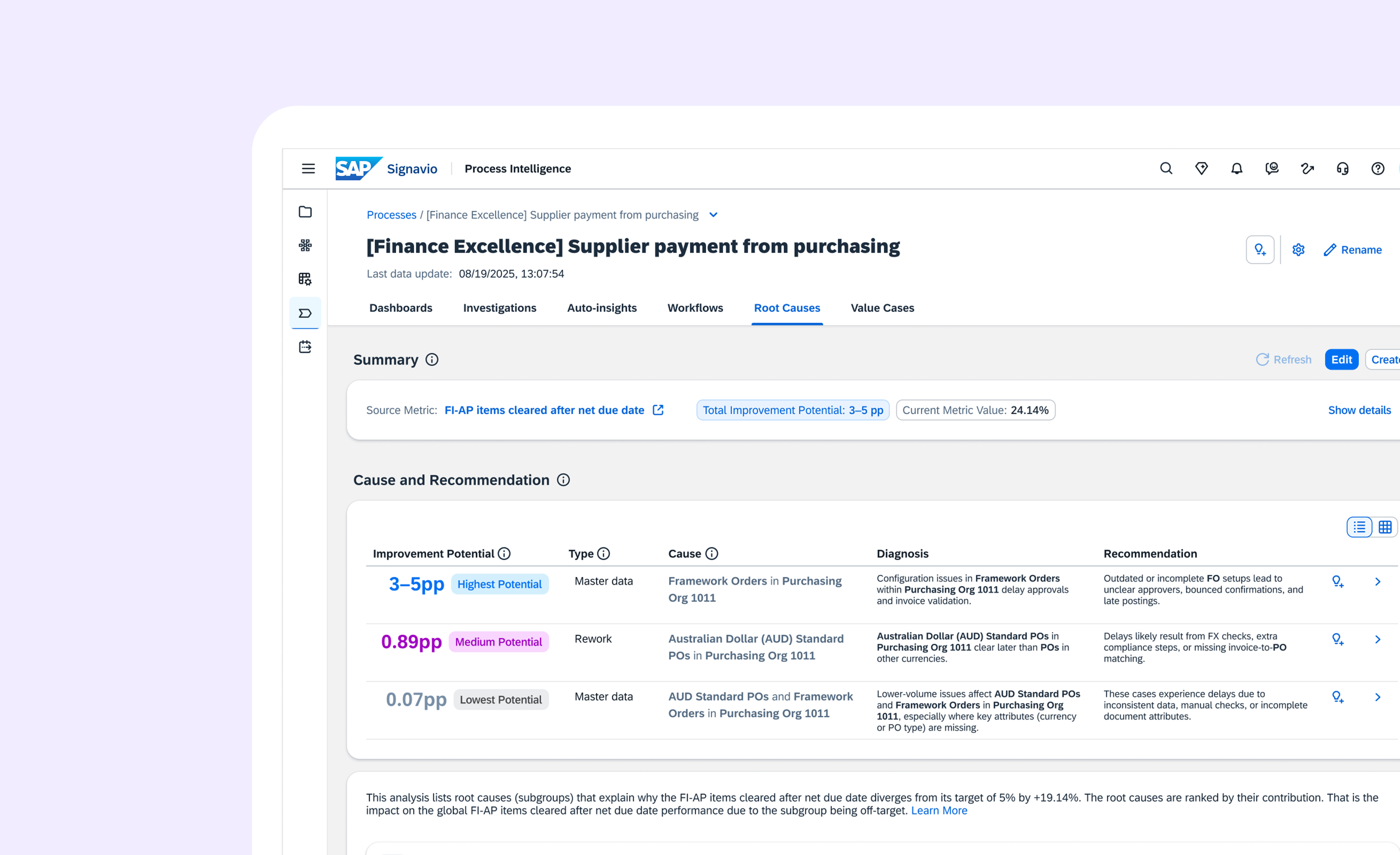
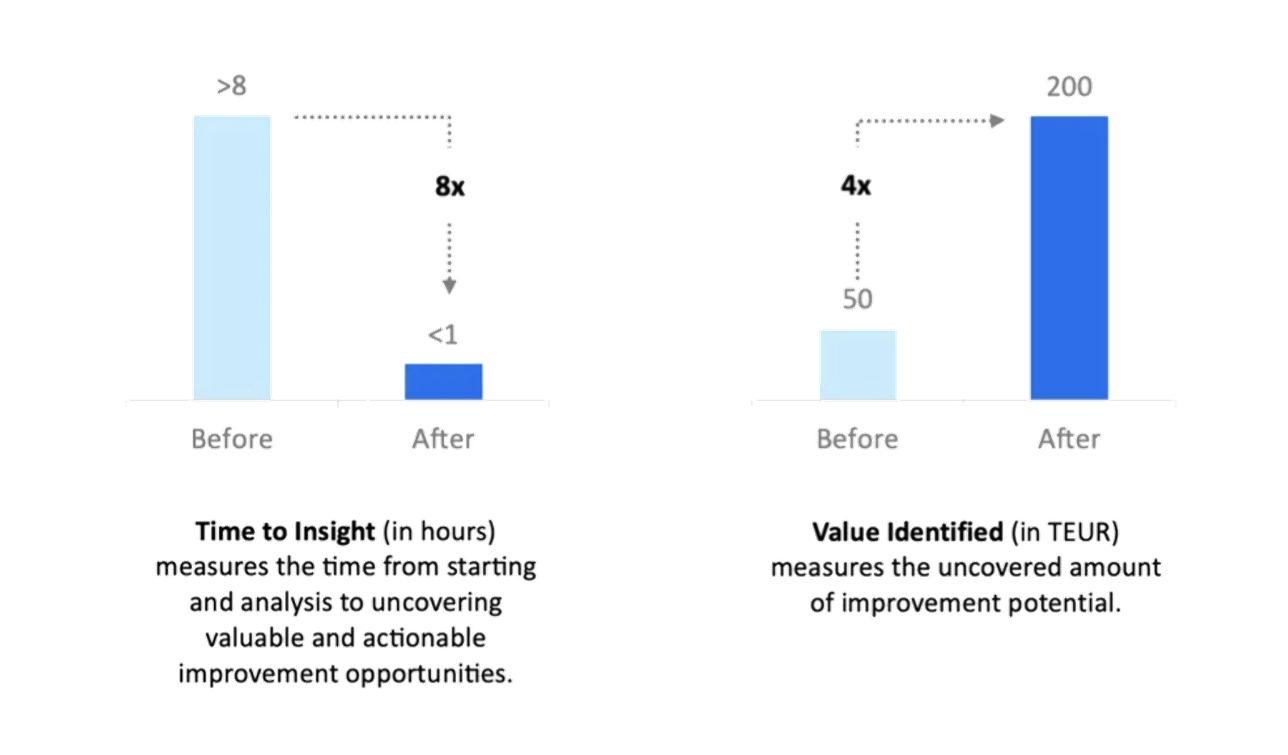
Automated RCA finds reasons why your metric is off target — uncovering improvement potential, offering reduction in time to insight and maximising value identified. Essential to move from manual to automated analysis.
01
AUTOMATED ROOT CAUSES
Never overlook an opportunity. Finds every driver there is in the data automatically, saving hours if not days validating all possible hypotheses.
02
IN SECONDS
Reduces time to insight by finding improvement potential in seconds, continuously — surfacing causes that positively and negatively impact process performance indicators.
03
PRIORITIZED BY VALUE
Prioritize initiatives according to their value. Ranks root causes by their precise improvement potential so you know exactly how to reach your target.
The MVP focused on a single, validated product slice: the Root Cause Analysis results page. This constrained scope allowed the team to test the core value hypothesis — that structured, ranked causal outputs could meaningfully reduce time-to-insight — before committing to broader platform integration.
The initial slice surfaced subgroups by contribution, provided deviation context against target, and enabled users to explore root cause drivers without requiring expert configuration.
Daimler Truck — the world's largest commercial vehicle manufacturer — identified EUR 200k worth of improvement potential using RCA, further improving operational excellence by reducing Time to Insight for the Rework Rate to a few minutes and minimising the number of transmissions that require rework.
- RCA's analytical depth was strong, but outputs were not decision-ready, requiring expert interpretation to act on results.
- Ranked subgroups and raw metrics increased cognitive load, slowing time-to-action and limiting value for non-analysts.
- The primary breakdown occurred at the decision layer, not the analysis layer.
- Users struggled to identify which drivers mattered most, why they mattered, and what to do next.
- This constrained adoption and led to missed high-impact improvement opportunities.
- RCA needed to evolve from an explanation tool into a prioritised, action-guiding system.
Solution Exploration & Trade-offs
I explored increasing raw analytical detail versus abstracting insights into simplified summaries. Expanding data visibility preserved flexibility but amplified cognitive load, while over-simplification risked reducing trust and analytical confidence.
The selected approach introduced an AI-assisted recommendation layer that prioritises drivers by quantified improvement potential and explains causality in plain language — while preserving access to underlying analysis. This intentionally traded exhaustiveness for actionability.
A high-fidelity, clickable prototype was produced for General Availability (GA), translating validated design decisions into a production-ready experience aligned with the Horizon design system.
- Duration: 1 week · 24–28 November (5 days)
- Participants: 7 — Business Analyst, Finance / Operations, Customer Success
- Format: 60 min User Interview & Concept Sharing per session
- Materials: Educational PPT, Figma Prototype, Mural Board (Notes)
- Insight categorisation: Neutral, Goodie, Issue
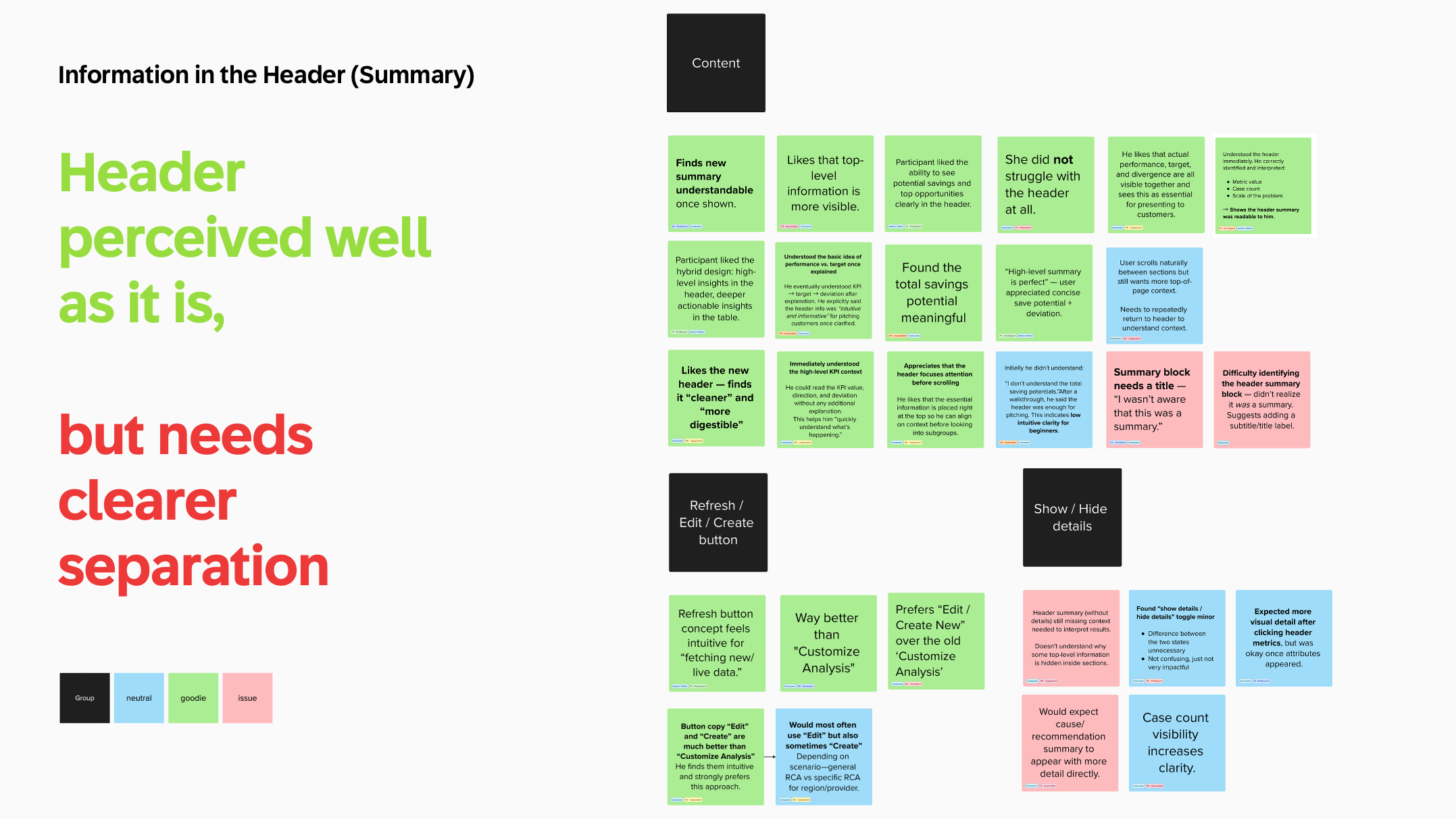
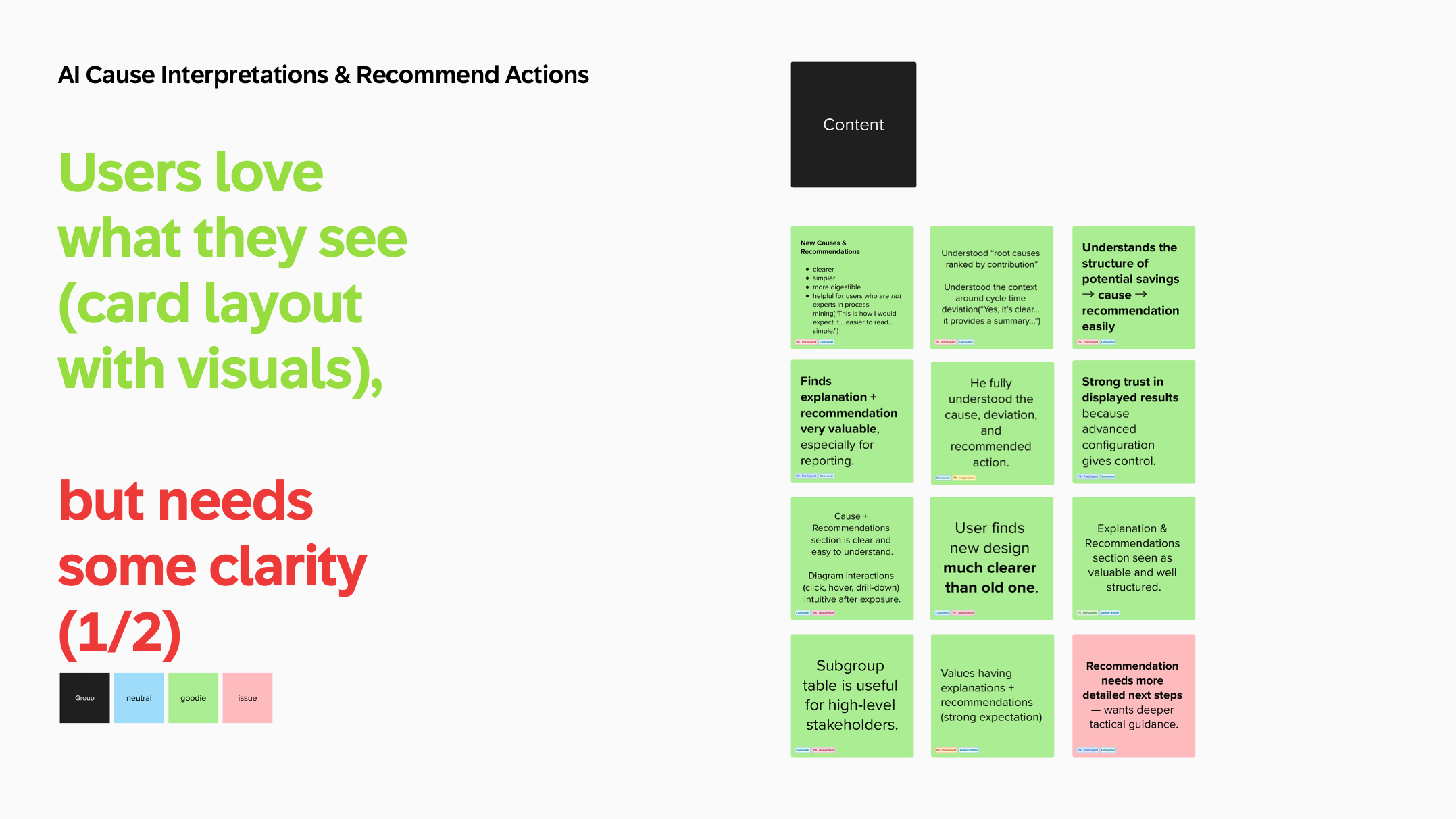
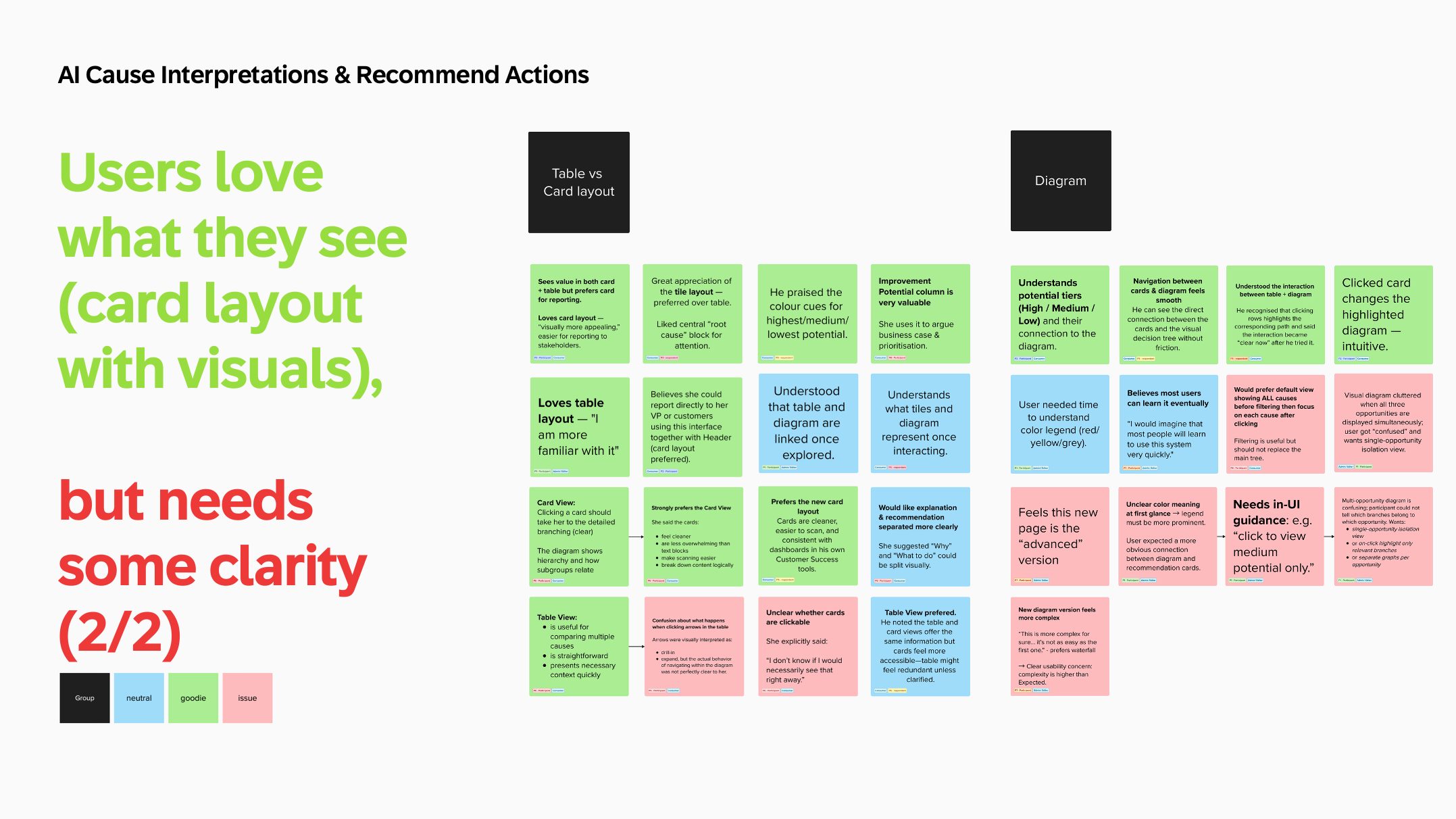
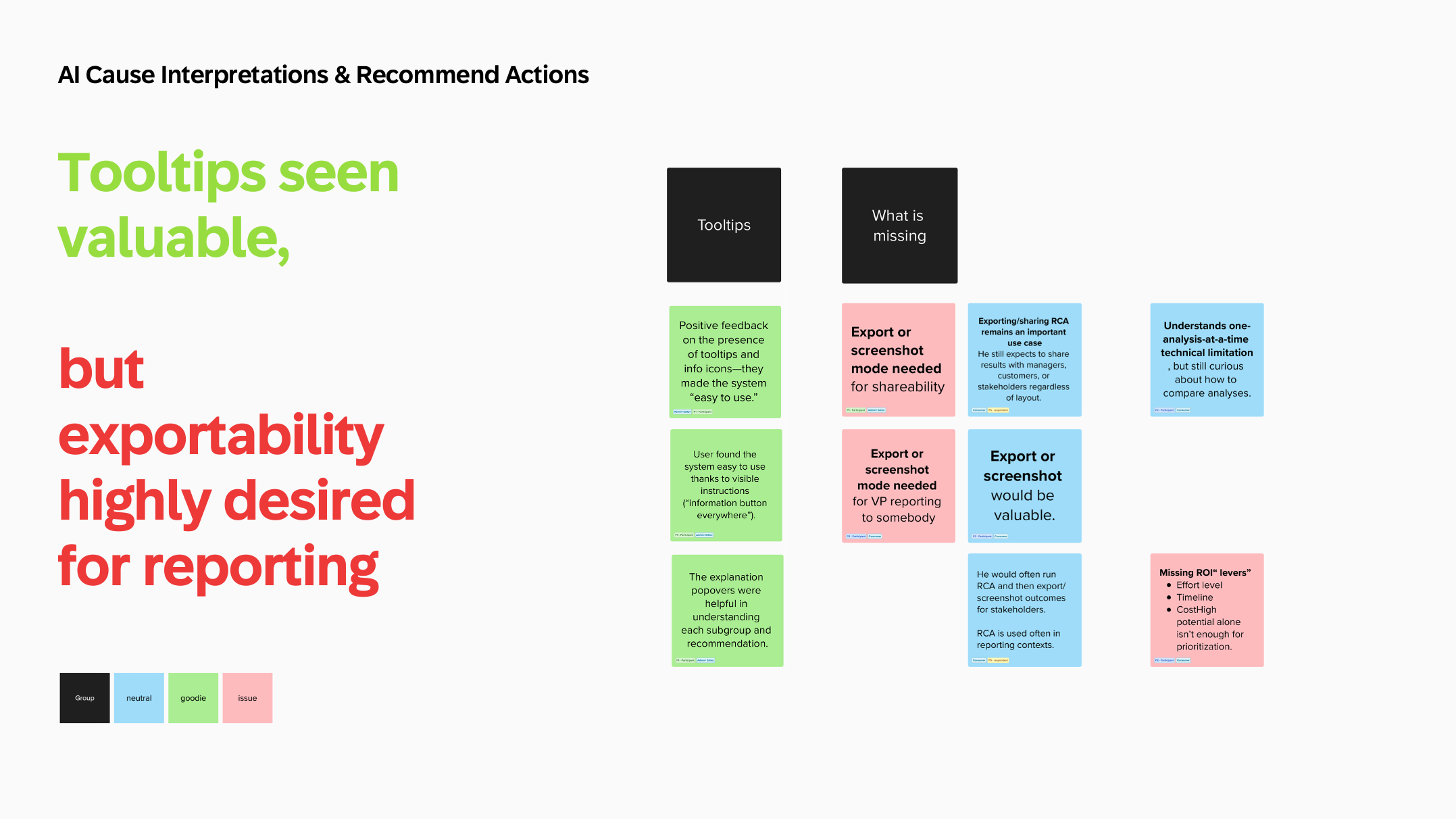
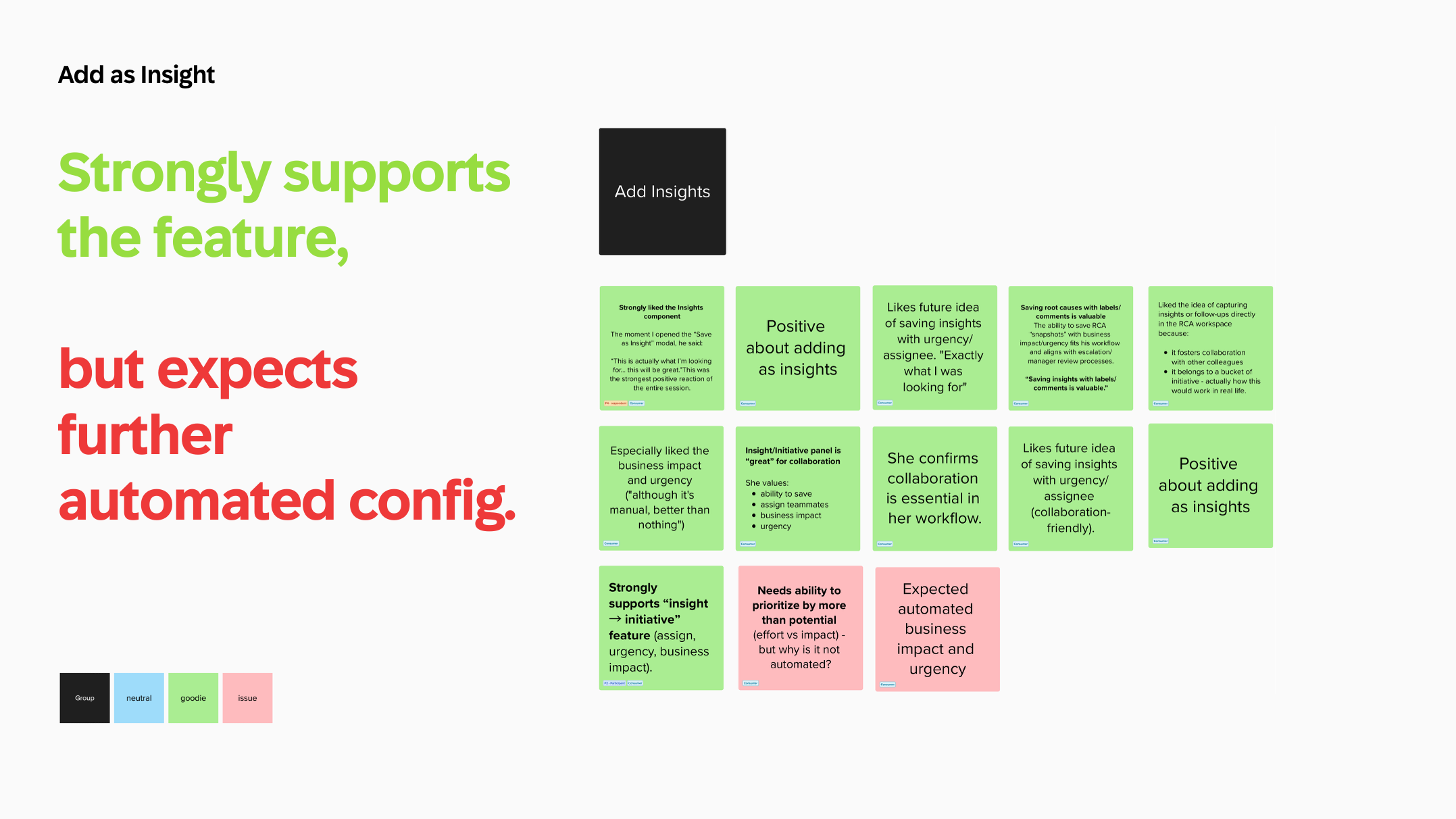
Validation confirmed the overall product direction and interaction model, particularly the effectiveness of AI-assisted recommendations and value-based prioritization. The primary risk identified was interpretation friction around RCA outputs for non-analyst users, which led to targeted refinements in explanation, ranking clarity, and actionability. These insights directly informed final design decisions and de-risked progression to high-fidelity execution for GA.
- AI-generated summaries and card-based interpretations validated the core RCA direction and were consistently trusted across user roles.
- The biggest usability gains depend on clearer structure and interaction affordances to accelerate understanding at deeper levels of analysis.
- AI Cause Interpretations and Recommended Actions reinforced RCA's positioning as a decision-ready system, not just an analytical surface.
- "Add as Insight" emerged as a critical bridge from analysis to action, with strong demand for automated impact prediction and urgency scoring.
- MVP learnings informed suite-level scaling decisions, shaping improvements in exportability, reporting, and cross-workflow integration.
Comparative SUS results between the MVP and GA releases show a 24.6% improvement in overall usability (+16.6 points). This indicates a meaningful increase in user confidence and efficiency, reflecting the cumulative impact of iterative design decisions and validation cycles as the product matured toward general availability.
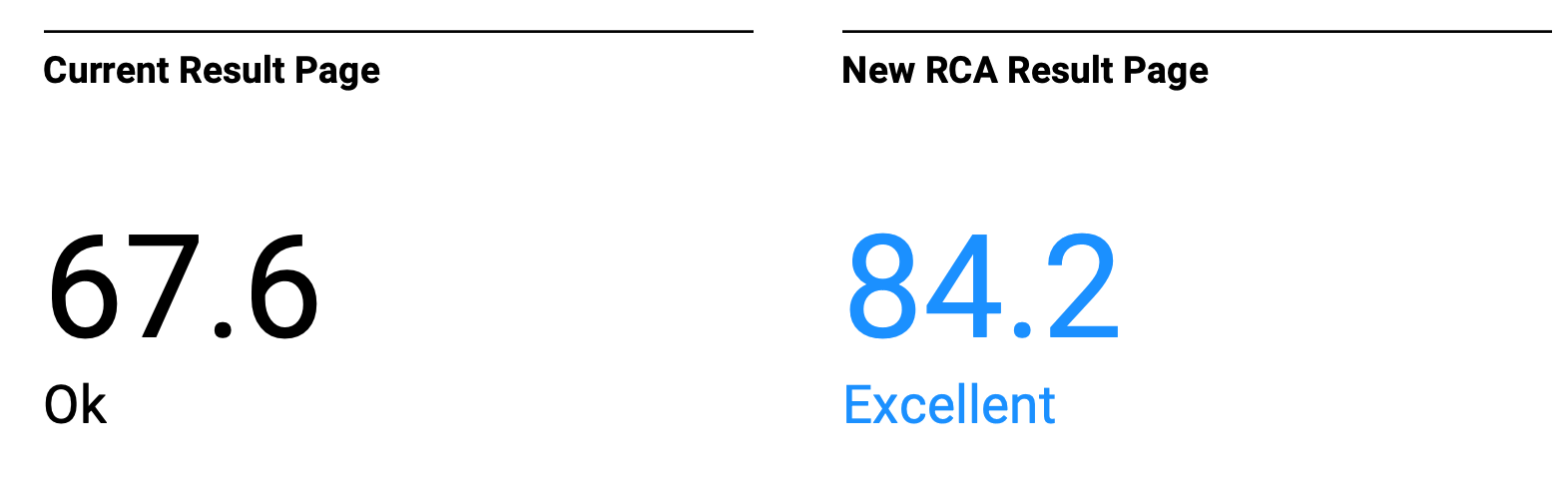
With usability moving from acceptable to excellent (SUS 67.6 → 84.2), future iterations should focus on scaling impact rather than fixing fundamentals.
Key areas of focus include:
- Deepening decision support by expanding predictive signals (impact, urgency, confidence) to further reduce manual interpretation.
- Strengthening cross-product consistency, extending the validated Value Analysis model across additional Signavio surfaces and workflows.
- Operationalizing insights, improving exportability, traceability, and integration into downstream reporting and stakeholder decision processes.
- Continuous validation at scale, using behavioral data (Pendo) and targeted experimentation to sustain usability and performance as complexity grows.
These iterations build on a validated foundation, ensuring the capability continues to scale confidently across enterprise use cases and the broader Signavio suite.